⚡ Emergency roof repairs 24/7 across Eastbourne — Call now: 01323 365960
⭐ 4.9/5 · 143 Google Reviews · 2026 Cost Guide

How Much Does a New Roof Cost in Eastbourne?

A new roof is one of the biggest single investments an Eastbourne homeowner makes, and prices vary widely with property type, tile choice and access. This page gives real 2026 figures for the local housing stock — from Langney concrete-tile semis to Meads clay-tile period homes — so you can budget before the survey.

📅 Get My Free Quote — Callback Within 2 Hours

Tell us the job in 30 seconds. No pushy sales, no call-out fee.

📞 Call Now: 01323 365960
20+
Years Local
143
5★ Reviews
24/7
Emergency
10yr
Guarantee
✓ NFRC Registered
✓ Fully Insured
✓ 10 Year Guarantee
✓ Free Quotes
✓ No Hidden Costs
✓ Family Run Since 2003
EmergencyRoof RepairsReplacementFlat RoofingGutteringChimneyFascias & SoffitsMoss RemovalInspectionsStorm Damage

Need a roofer in Eastbourne? Call free on 01323 365960 — we answer 7 days a week.

01323 365960
2026 Cost Guide

What Does a New Roof Cost in Eastbourne?

A new roof in Eastbourne typically costs £5,500–£9,500 for a concrete-tile 3-bed semi, £7,500–£12,000 in clay, and £8,000–£16,000+ for period properties in matched natural materials. Prices include scaffold, strip, membrane, battens, Code 5 lead and VAT, with a 10-year workmanship guarantee. Free surveys — call 01323 365960.
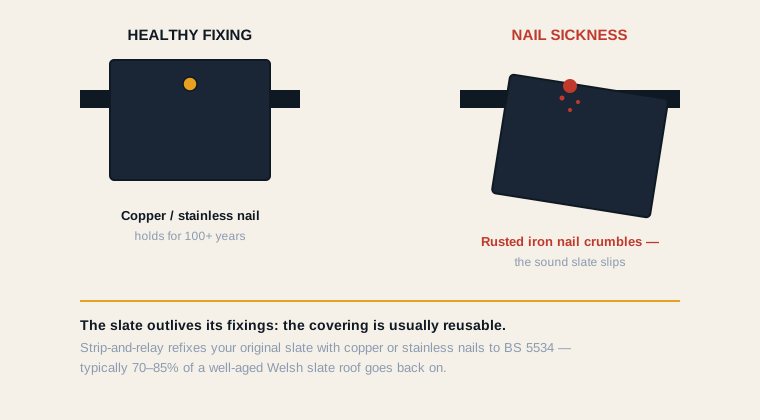
Diagram comparing a sound roof fixing with a corroded nail that lets a slate slip
Nail sickness: corroded fixings let sound tiles and slates slip — the classic sign a roof needs re-fixing or replacement.
Honest advice

Do You Actually Need Roof Replacement?

A full re-roof is a big spend, so the first question is whether you actually need one. Here is how to tell an end-of-life roof from one that just needs repair.

  • Tiles slipping across several slopes at once, not just one spot (classic nail sickness)
  • Repeated repairs in a short space of time — you are renting time on a failing roof
  • Sagging roofline, or bowing felt and battens visible in the loft
  • Widespread slate delamination or crumbling concrete tiles
  • Damp getting in despite recent repairs

When it is not the answer: If the damage is localised and the covering has years of life left, a targeted repair is the right call and a full re-roof would be oversell — we will tell you so. Read the full guide.

Local knowledge

Eastbourne Stock & Local Factors

When an Eastbourne roof reaches the end of its life, the right replacement tracks the housing era. The concrete-tile estates of Langney and Shinewater are the classic re-roof candidates once nail sickness has spread across the slopes — the tiles are often sound, but the whole roof is slipping, and a strip-and-re-cover or full replacement ends years of patch repairs. On Meads and Old Town period stock, replacement usually means natural slate or clay to match the conservation-area character, with lime mortar and traditional detailing rather than the cheapest modern interlocking tile.

Coastal exposure shapes every Eastbourne re-roof. We fit breathable membrane, correct the ventilation that older roofs often lack, and use marine-grade lead and stainless fixings throughout, because the salt air that shortened the old roof's life will test the new one just as hard. On exposed western and seafront elevations we also pay particular attention to verge and ridge fixing — dry-verge systems and mechanically-fixed ridges resist the south-westerly wind far better than the old mortar-bedded details they replace.

The process

What to Expect: Roof Replacement in Eastbourne

1. Survey & measure

We assess the covering, battens, felt and structure, confirm whether it is genuinely end-of-life, and measure for materials.

2. Specification & written quote

You get an itemised specification — covering, breathable membrane, battens, lead code, ventilation and scaffold — as a fixed written price.

3. Scaffold & scheduling

Full scaffold goes up with the licence arranged; we agree a start date and a realistic weather-aware duration.

4. Strip & dry-in

We strip the old covering, replace defective battens, fit breathable membrane and make the roof watertight each evening.

5. Re-cover & detail

New covering, ridge, verge, valleys and leadwork to BS 5534, with ventilation corrected.

6. Cleanup, sign-off & guarantee

Full clear-up and waste removal, walk-round, and handover of your written 10-year guarantee.

Timescales

How Long Does It Take?

JobTypical duration
Garage / outbuilding re-roof1–2 days
Terraced house re-roof3–5 days
3-bed semi re-roof5–8 days
Large detached / complex roof8–12 days

Re-roofs are weather-dependent; we dry-in each evening so the house is never left open, and build spare days into the programme for Eastbourne's coastal weather.

Access

Getting Safely onto Eastbourne Roofs

A re-roof always needs full scaffold; we arrange the licence and it is itemised in your quote, never a hidden extra. Scaffold is specified for: the whole roof — full independent scaffold is standard on every re-roof - always itemised in your written quote, never a hidden extra, and we arrange it.

Eastbourne's Victorian and Edwardian terraces in Meads, Upperton and Old Town often have no side access, so scaffold reaches the rear over the roofline or through the property; seafront mansion blocks need tall scaffold licences for parapet and stack work. Pavement scaffold and skip permits go through East Sussex County Council; allow a few working days on streets like Church Street in Old Town, the terraces off Seaside, Grange Road in Upperton where space is tight.

Pricing

Roof Replacement Prices in Eastbourne

JobTypical rangeNotes
Garage / outbuilding£1,800–£3,500Size and covering
Terraced house re-roof£5,000–£8,500Incl. scaffold
3-bed semi re-roof£7,500–£12,000Concrete or clay tile
Natural slate re-roof£12,000–£18,000+Meads/Old Town period stock
Detached / complex£12,000–£20,000+Multiple slopes, dormers

What moves the price

  • Roof size, pitch and number of slopes, dormers and valleys
  • Covering — concrete interlocking vs clay vs natural slate (conservation matching in Meads)
  • Scaffold scale, especially tall seafront and no-access terraced sites
  • Whether battens, membrane and structural timber need replacing
  • Marine-grade lead and stainless fixings as standard on the coast

Worked example: A concrete-tile re-roof on a 1970s 3-bed semi in Langney, including full scaffold, breathable membrane and dry-verge: about £9,200.

Staged payments across the job — a fair schedule agreed up front, with nothing paid before materials and scaffold are on site.

Covering BN20, BN21, BN22, BN23, BN24 and surrounding postcodes.

Guarantee

Your Guarantee, Explained

The complete re-roof carries a 10-year workmanship guarantee in writing, transferable if you sell; tiles, membrane and lead carry their own manufacturer warranties.

  • Covered: workmanship for 10 years, in writing, transferable if you sell.
  • On top: manufacturer warranties on materials (terms vary by product).
  • Not covered: storm or impact damage - that is an insurance matter, and we will document it for your claim.

If a fault appears in covered work, we come back and put it right. No quibbling, no re-charge.

Good to know

What It Is Like While We Work

A re-roof means a skip, a scaffold and several days of activity. You can stay in the house throughout — it is external work — and we protect drives, planting and boundaries and sweep for nails daily. You do not need to stay home for external work - we just need power and access agreed in advance.

Re-roofing runs through most of the year; we dry the roof in each evening so rain never gets into the house between working days. Channel salt air ages lead and fixings faster here than inland, and the south-west prevailing wind drives rain onto exposed western and seafront elevations, so we build weather margin into every Eastbourne booking.

What Goes Into a Re-Roof Price

A re-roof quote is not just tiles. Around a third of the cost is labour, a fifth is scaffold and safe access, and the rest covers strip and disposal, breathable membrane, pressure-treated battens, the tile covering itself, all lead flashings, and the guarantee. On a typical Eastbourne semi the covering material is often the smaller line — the value is in the fixing detail and the lead, which is where cheap quotes cut corners.

Tile Choice Drives the Range

Concrete interlocking tile is the most economical covering and suits the post-war estate stock across Langney, Shinewater and Hampden Park. Machine-made clay costs more but lasts longer and holds colour. Handmade clay plain tile and natural Welsh slate — the correct materials for Meads, Upperton and Old Town period properties — sit at the top of the range because of both the material and the slower, more skilled laying involved.

Scaffold and Access

Scaffold is a fixed cost on almost every two-storey Eastbourne re-roof, required for safe working at height. Terraced streets in Upperton and Old Town where there is no side access, or properties on the steep roads around Meads, can add to the scaffold figure because of the design and duration needed. Where a job affects the public footway, an East Sussex County Council highway licence may also be required.

The Strip Phase and Hidden Costs

Once the old covering is off, the true condition of the timber is visible. Perished felt is expected and priced in, but rotten batten ends, decayed rafter feet or failed valley boards are sometimes only found at strip. A reputable Eastbourne roofer photographs anything found and quotes it transparently before continuing — the quotes to distrust are the ones that make no mention of what happens if the deck is not sound.

Guarantees and What They Cover

A 10-year written workmanship guarantee should be handed over on the day of completion, separate from the manufacturer warranty on the tiles and membrane. It should name the property, the work, and the terms. Insurance-backed guarantees through schemes tied to NFRC membership give additional protection if the contractor ceases trading — worth asking about on a five-figure Eastbourne re-roof.

Local Knowledge

New Roof Costs by Eastbourne Property Type

The single biggest driver of a new roof price in Eastbourne is which era of housing you own. The post-war concrete-tile estates — Langney, Shinewater, the Brodrick Road side of Hampden Park — are the most economical to re-roof because the concrete interlocking covering is inexpensive and the roof shapes are simple. These are also the properties most affected by nail sickness, so re-roofing rather than repeated patch repair is often the better-value decision once fixing failure is widespread.

The 1930s hipped semis of Roselands and the older parts of Hampden Park cost a little more because hipped roofs have more cut detail, more lead, and more ridge and hip line to bed. Victorian and Edwardian properties in Upperton, Old Town and especially Meads sit at the top of the range: handmade clay plain tile or natural Welsh slate, hydraulic lime mortar, Code 5 lead throughout, and the slower laying these materials demand. In the Meads and Old Town conservation areas, matching the original material is not optional, which removes the cheaper concrete route entirely.

Coastal exposure quietly raises the Eastbourne baseline compared with inland towns. Salt air shortens the life of under-specified lead and fixings, so Code 5 lead and stainless fixings are the correct standard here rather than an upgrade — and any quote priced on Code 4 lead or galvanised fixings is priced for a different climate. Properties at Sovereign Harbour and along the seafront see the most aggressive marine exposure of all.

New Roof or Repeated Repairs? The Break-Even in Eastbourne

The decision most Eastbourne homeowners actually face is not 'what does a new roof cost' in isolation, but whether a re-roof beats another round of repairs. On the post-war concrete-tile estates of Langney and Shinewater the maths is often stark: once nail sickness is widespread, tiles keep slipping across the whole roof, and each patch buys only months before the next call-out. Three or four repair visits at £150–£400 each, plus the internal damage from every leak that gets in first, quickly approach the cost of a re-fix or re-roof that solves it permanently.

For period homes in Meads, Upperton and Old Town the calculation is different but the principle holds. Isolated slate slippage or a single failed valley is worth repairing; comprehensive slate delamination or lead that has reached the end of its life across multiple slopes points to replacement. An honest Eastbourne roofer gives you the break-even, not just a price — and we will tell you plainly when your roof has years left and a repair is the right call, because a re-roof you do not yet need is money wasted.

How to Get the Most Accurate New Roof Quote

The accuracy of a re-roof quote depends on the survey behind it. A figure given over the phone or from the pavement is a guess; a proper quote follows a roof-level or loft-level inspection that establishes the covering condition, the timber, the lead and the correct tile specification for your property and area. That is why our surveys are free — the quote is only worth having if the inspection behind it is real.

To compare Eastbourne quotes fairly, make sure each one specifies the same things: the lead code (Code 5 is correct on this coast), the fixings (stainless), the scaffold, whether dry-verge and dry-ridge are included, and how hidden timber repair is handled if found at strip. A quote that omits these is not cheaper — it is simply less complete, and the gap usually reappears as an 'extra' once the work is underway.

Finally, treat the survey itself as part of the value. A roofer who takes the time to inspect the loft space, check the timber and explain the specification for your particular Eastbourne property is showing you how they will approach the whole job. A five-figure re-roof is worth an hour of careful survey before a penny changes hands, and any contractor unwilling to give you that is telling you something useful about how the work would go.

Transparent Pricing

New Roof Cost — Eastbourne 2026

The figures below are realistic 2026 installed prices for Eastbourne and the surrounding East Sussex towns, at the southern-England labour band. Every price includes scaffold, strip and disposal, membrane, battens, covering, lead flashings and VAT. Period and conservation-area work is priced per specification after survey.

Bungalow, concrete tile£3,500–£6,500
3-bed semi, concrete tile£5,500–£9,500
3-bed semi, machine-made clay£7,500–£12,000
4-bed detached£8,000–£14,000
Period property, matched clay or Welsh slate£8,000–£16,000+
Welsh slate (per m² guide)£180–£280/m²

Where more than 25% of a roof slope is renewed, the work is notifiable under Building Regulations and may trigger a requirement to upgrade roof insulation to current standards.

Source: Building Regulations Approved Document L (conservation of fuel and power)

Free survey and honest, written quotes across Eastbourne and East Sussex.

01323 365960
Eastbourne Reviews

What Eastbourne Customers Say

★★★★★

“Re-roofed our concrete-tile semi after years of slipping tiles. The quote was itemised down to the scaffold and lead, no vague lump sum. Came in exactly as quoted even after they found a couple of rotten batten ends.”

Kevin J. · Hampden Park
★★★★★

“Full clay re-roof on our Edwardian house. They matched the original tile properly and used lime mortar throughout — you can't tell it's new. Worth every penny over the cheaper concrete quote we'd had.”

Helen T. · Upperton
★★★★★

“Got three quotes for a new roof in Meads and theirs was the only one that mentioned conservation area materials before I did. Straight, knowledgeable, and the guarantee paperwork was handed over on the day.”

Caroline W. · Meads
Questions Answered

How Much Does a New Roof Cost in Eastbourne — FAQs

For a typical 3-bed semi, £5,500–£9,500 in concrete tile and £7,500–£12,000 in clay. Period properties in matched natural materials run £8,000–£16,000+. All figures include scaffold, strip, membrane, battens, lead and VAT.

The materials cost more and they take longer to lay. Handmade clay plain tile and natural Welsh slate — the correct coverings for Meads, Upperton and Old Town period homes — also require more skilled detailing and Code 5 lead throughout, which raises the total.

A like-for-like re-roof usually does not. Conservation-area properties in Meads and Old Town may need consent for any change of material, and re-roofing more than 25% of a slope is notifiable under Building Regulations. We advise before every quote.

A standard 3-bed Eastbourne semi takes 3–5 working days. Period properties with conservation material requirements can take 5–8 days. We provide a programme with the quote and keep you updated each day.

Scaffold erection and removal, full strip and disposal, breathable membrane, new pressure-treated battens, the tile covering, all lead flashings to Code 5, dry-ridge fixing on exposed aspects, site clearance, VAT and a 10-year guarantee.

We photograph it, explain it, and quote it before continuing — no work proceeds on hidden extras without your agreement. Perished felt is expected and already priced in; structural timber repair is only occasionally needed.

Compare like for like. A quote is only cheaper if it specifies the same lead code, the same fixings and the same scaffold. On Eastbourne's coast, Code 4 lead and galvanised fixings are false economy that fails years sooner in salt air.

Related Services

Related Roofing Services in Eastbourne

Roof Replacement Roof Repair Costs Roof Inspections How to Choose a Roofer Flat Roof Costs Emergency Roofing
Get In Touch

Free Quote — No Obligation

Call a local Eastbourne roofer who knows your area and your property type.

01323 365960 ✉ Email Instead
📞 Call📅 Free Quote Callback