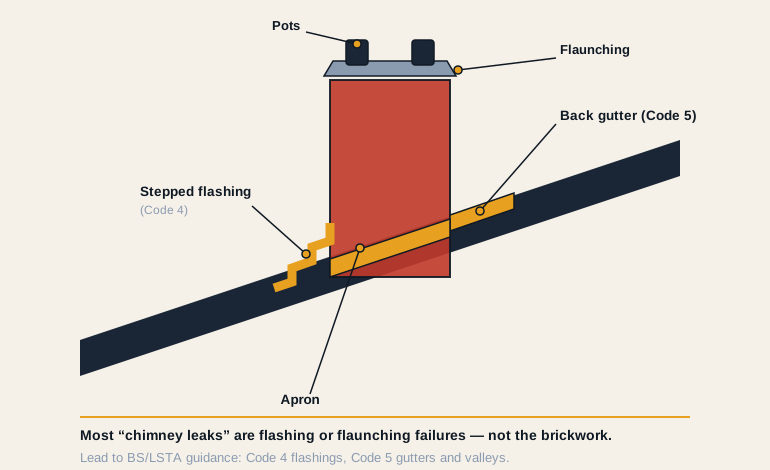
Chimney stacks on period properties in Eastbourne, Meads, Bexhill, and Seaford are among the most exposed structural elements on any building. Tall Victorian and Edwardian stacks — often with four or six pots, decorative corbelling, and complex lead flashing details — present a large cross-section to south-westerly weather systems and accumulate salt deposition faster than any other part of the building envelope.
The Four Most Common Chimney Problems in Eastbourne
1. Lead flashing failure. The most common single chimney repair call across Eastbourne's period housing stock. Salt-accelerated corrosion at lead bends and joints — exacerbated by the thermal cycling of a hot chimney breast in a cold ambient air mass — causes step and cover flashings to fail 30–50% faster than equivalent work on sheltered inland properties. The result is persistent, often intermittent water ingress to the chimney breast that causes internal damp months or years before the external failure is apparent.
2. Mortar joint failure. The external mortar joints of chimney stacks above roof level are among the most exposed pointing on any building. Thermal cycling, freeze-thaw in harder winters, and the physical erosion from wind-driven rain and salt deposition erode mortar joints progressively. Comprehensive repointing at the stack head is required approximately every 15–20 years on Eastbourne coastal properties — less in exposed positions in Meads and Seaford.
3. Flaunching failure. The flaunching is the conical mortar bed that holds chimney pots in position. Flaunching crumbles with age and salt exposure, eventually releasing pots into an unstable position — a genuine safety risk in storm conditions. Flaunching replacement is a routine but important maintenance item on all Eastbourne period stacks.
4. Brick spalling. Previous incorrect repair work using Portland cement on soft Victorian brickwork has caused spalling — progressive loss of brick faces — on thousands of Eastbourne properties. The cement, being harder than the brick, transfers stress to the brick face during thermal movement. The only correct remediation is to carefully cut out all Portland cement joints and replace with lime mortar, then allow the brickwork to stabilise.
Chimney Repair Costs in Eastbourne (2025)
| Repair Type | Typical Cost |
|---|---|
| Lead step & cover flashing (Code 5) | £350–£700 |
| Full stack repoint (lime mortar) | £300–£800 |
| Flaunching replacement (per pot) | £80–£200 |
| Pot replacement (per pot) | £100–£300 |
| Partial stack rebuild (top 5–10 courses) | £800–£2,500 |
| Full chimney stack removal | £1,200–£3,000 |
| Chimney cap/cowl installation | £100–£300 |
Free Chimney Inspection — Eastbourne and East Sussex
Scaffold-access inspection, written condition report, itemised quote. Call 01323 365960 or request a callback.
Call 01323 365960Why We Require Scaffold Access for Chimney Work
Chimney repointing and flashing replacement carried out from a ladder is not safe and is not technically adequate. A roofer on a ladder adjacent to a chimney cannot exert the pressure required for proper mortar joint preparation, cannot safely handle sheet lead, and cannot inspect all four faces of a tall stack. All chimney quotation and repair work by our team requires scaffold or cherry picker access. Any contractor quoting chimney repointing or major flashing work without scaffold access should be questioned carefully about how they intend to execute the work safely.
When Chimney Repair Becomes Chimney Removal
Chimney stacks that are no longer serving active fireplaces or heating appliances are structurally redundant. An unmaintained redundant stack accumulates repair cost indefinitely. On properties in Langney, Hampden Park, and other post-war areas where original fireplaces have been removed, taking down the internal stack and capping at roof level is often better long-term value than indefinite maintenance of a stack with no functional purpose. We'll advise honestly on this question where it's relevant.