Facing a roof problem and a big decision? This honest guide walks you through repair versus replacement for Eastbourne's housing — from nail-sick estate roofs to century-old Meads slate — using the same framework a good roofer uses, so you can spot a fair recommendation from an oversell.
Repair when damage is localised and the rest of the roof has years left; replace when more than about a third of the covering has failed, fixings are gone across the roof, or you are spending repeatedly. The honest test is cost per remaining year of roof life. Free survey — call 01323 365960.
✓ NFRC Registered
✓ Fully Insured
✓ 10 Year Guarantee
✓ Free Quotes
✓ No Hidden Costs
✓ Family Run Since 2003
The decision
Repair or Replace: How to Decide
Almost every Eastbourne homeowner facing a roof problem is really asking one question: is this a repair, or is it time for a new roof? The honest answer depends on three things — how much of the roof has failed, how old the covering and its fixings are, and how much you are already spending on repeat visits. This guide gives you the framework a good roofer uses, so you can tell a fair recommendation from an oversell.
The single most useful measure is cost per remaining year of roof life. A £400 repair on a roof with fifteen good years left is cheap protection. The same £400 spent every eighteen months on a roof that is fundamentally failing is the most expensive way to own a roof — you are renting time on something that needs replacing.
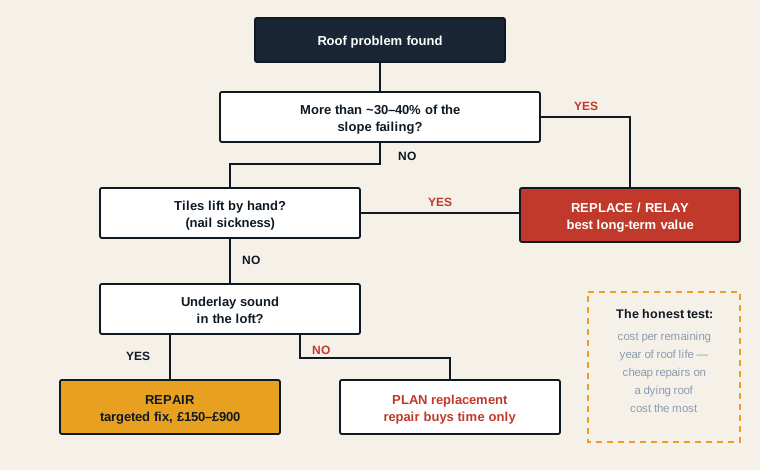
Repair-or-replace decision tree: localised damage on a sound roof points to repair; widespread failure points to planned replacement.By Eastbourne stock
Repair or Replace by Eastbourne Property Type
The right answer tracks the housing era. On the post-war concrete-tile estates of Langney, Shinewater and the Brodrick Road side of Hampden Park, the deciding factor is nail sickness. When the galvanised fixing nails corrode, tiles slip across the whole roof at once. A slipped tile or two is a repair; slipping across every slope is comprehensive fixing failure, and a strip-and-re-fix or re-roof ends it for good rather than funding a rolling programme of patch visits.
On Victorian and Edwardian stock in Meads, Upperton and Old Town, natural slate and clay can last a century, so the question is usually about the lead and the fixings rather than the covering. Isolated slate slippage, a single failed valley or a length of tired flashing are repairs. Widespread slate delamination, or lead that has reached the end of its life across several slopes, points to planned re-covering — often in matched materials where the conservation area requires it.
On 1930s hipped semis in Roselands and older Hampden Park, the recurring issue is 85–90-year-old hip and ridge mortar plus ageing felt beneath. Re-bedding and repointing buys real time here; a full re-roof becomes the better value only once the covering itself is porous or the battens and felt have gone. Coastal salt is the constant multiplier across all of these — it ages lead and fixings faster in Eastbourne than inland, which is why the fixings so often fail before the tiles do.
The framework
The Repair-or-Replace Framework
1. Extent of failure
How much of the roof is affected? Isolated, accessible damage favours repair. Failure spread across multiple slopes — the classic sign of nail sickness or end-of-life covering — favours replacement.
2. The 30% rule of thumb
Once roughly a third of the covering or its fixings have failed, tile-by-tile repair usually costs more over time than re-roofing. Below that threshold, targeted repair is normally the better value. Treat it as a guide, weighed against age and condition.
3. Cost per remaining year
Divide the likely spend by the honest remaining life. A repair that buys fifteen years is excellent value; repeated repairs on a roof with two years left are not. This is the test that cuts through both under- and over-spending.
4. Your plans
Staying twenty years? Investing in a re-roof with a transferable guarantee can make sense at the right point. Selling soon? A sound roof reassures buyers, but over-capitalising on a re-roof you do not need rarely pays back. We factor this in rather than defaulting to the biggest job.
Free survey and honest, written quotes across Eastbourne and East Sussex — callback within 2 hours.
When Replacement Is Oversell — and When Patching Is Wasted
When patching is money wasted: if tiles are slipping across the whole roof, if you have paid for three or more repairs in a couple of years, or if the felt and battens have perished, each new patch buys only months. At that point the repeated spend, plus the internal damage from every leak that gets in first, quietly exceeds the cost of doing it once properly.
When replacement is oversell: if the damage is localised, the covering has clear years of life, and a targeted repair restores the roof, a full re-roof is selling you something you do not need. A trustworthy Eastbourne roofer will say so and quote the repair — and will put the reasoning in writing. If a quote jumps straight to a five-figure re-roof for an isolated fault, get the honest second opinion.
Repair: localised damage, sound covering, years of life left.
Re-fix / partial: nail sickness or mortar failure across the roof, covering still good.
Replace: covering at end of life, widespread failure, or repeated repairs outrunning the value.
Worked examples
Cost Per Remaining Year: Three Eastbourne Examples
The framework is easiest to see in numbers. These are typical Eastbourne scenarios, not quotes — every roof is surveyed on its merits.
1930s semi, Roselands — repair wins. Two slipped tiles and tired ridge mortar on an otherwise sound roof with 25+ years of life. A £450 repair and re-bed protects a roof worth many thousands to replace: barely £18 per year of protection bought. Replacing now would be textbook oversell.
1970s concrete-tile estate, Shinewater — the tipping point. Tiles slipping on two of four slopes, nail sickness confirmed, covering still sound. Patching individual tiles at ~£200 a visit, three visits a year and rising, buys months each time. A strip-and-re-fix ends it: over the roof's remaining 15 years the re-fix costs far less per year than the escalating patch bill — and stops the internal damage each leak causes.
Victorian terrace, Upperton — plan replacement. Widespread slate delamination and end-of-life lead across several slopes on a 110-year-old roof. Repairs here are money into a roof with little life left; a planned re-covering in matched materials, budgeted over a year, is the honest call — and adds real reassurance for a future sale.
Questions Answered
Repair or Replace Your Roof in Eastbourne — FAQs
Repair if the damage is localised and the roof is otherwise sound with years of life left. Replace if more than roughly a third of the covering has failed, the fixings have gone across the whole roof, or you are paying for repeat repairs. A survey settles it honestly.
A rule of thumb: once around 30% or more of a roof's covering or fixings have failed, repairing tile-by-tile usually costs more over time than re-roofing. Below that, targeted repair is normally the better value. It is a guide, not a law — condition and age matter too.
Nail sickness shows as tiles slipping across the whole roof, not just one spot, on post-war concrete-tile estates like Langney and Shinewater. The tiles are fine; the galvanised nails have rusted through. Once it is widespread, a re-fix or re-roof beats endless patching.
Yes. Replacing a roof with isolated, repairable damage and years of life left is oversell. A good roofer will tell you when a repair is the right call and decline to sell you a re-roof you do not need — and put that in writing at survey.
Concrete interlocking tile lasts 40–60 years, clay 60–100+, natural slate 80–120, felt flat roofs 15–25, and modern GRP/EPDM 25–50. Coastal salt shortens lead and fixing life, so the fixings often fail before the covering here.
For selling, a sound roof with a transferable guarantee reassures buyers and surveyors more than a patched one. But over-capitalising on a re-roof you do not need rarely pays back. Match the spend to the roof's actual condition and your plans.
Yes. If another roofer has quoted a full re-roof, we will survey and tell you plainly whether the roof genuinely needs it or whether a repair will do. The survey fee is credited against any work you book, so an honest answer costs you nothing.