Nail sickness is the systematic corrosion of galvanised tile-fixing nails, affecting most Eastbourne homes built between 1950 and 1985. Slipped tiles are the visible sign of comprehensive fixing failure. The two real fixes are stainless steel re-fixing or full re-roofing — individual tile replacement does not solve it. Free surveys diagnose the extent.
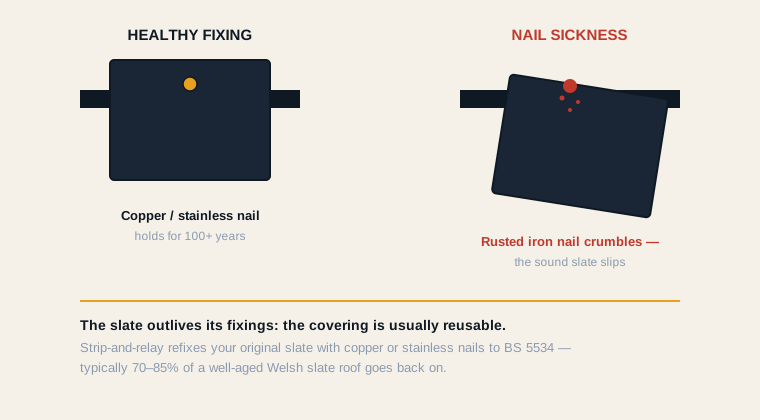
Nail sickness is the term for the systematic corrosion and failure of the galvanised steel nails used to fix concrete interlocking tiles on post-war and 1960s–70s housing. In Eastbourne, it affects the majority of properties built between approximately 1950 and 1985 — the Shinewater estate in Langney, the Brodrick Road area of Hampden Park, the Polegate and Willingdon housing estates, and thousands of individual semis and detached properties across the area.
Why Nail Sickness Happens
Galvanised nails have a finite service life. In the conditions present in a typical Eastbourne roof void — persistent moisture, condensation cycling, and the coastal salt air that penetrates even well-ventilated spaces — the zinc galvanising layer oxidises within 40–60 years. Once the galvanising is gone, the steel nail rusts rapidly. A rusted nail loses its grip on the tile batten and eventually fails to hold the tile in position. When a tile slips or falls, it's rarely an isolated event — it means the rest of the nails on that roof are at the same point in their corrosion cycle.
Galvanised steel tile nails have a typical service life of 40–60 years before zinc depletion and corrosion cause fixing failure, after which re-fixing or re-roofing is required.
Source: NFRC technical guidance on tile fixing
How to Tell If Your Eastbourne Property Has Nail Sickness
The definitive test requires a roofer to lift a section of tile at ridge level and inspect the fixing nails directly. Signs that suggest nail sickness may be present without roof access:
- Tiles that have slipped down slightly and are no longer flush with adjacent tiles
- Multiple separate tile losses on the same roof over a short period
- Your property was built between 1950 and 1985 and has never had a re-roof
- Orange or rust staining visible below tile edges when viewed from the gutter line
- A roofer who replaced individual tiles reporting that the nails in adjacent tiles crumbled when touched
The Problem With Individual Tile Replacement on Nail-Sick Roofs
The most common short-term response to a slipped or fallen tile on an Eastbourne nail-sick property is to replace the individual tile. This addresses the immediate symptom but not the cause. If the fixing nails across the roof are at the same stage of corrosion — which they will be, having been installed at the same time — replacing one tile leaves you with a roof that will continue shedding tiles indefinitely. We are honest with homeowners about this: individual tile replacement on a comprehensively nail-sick roof is not good value.
Free Nail Sickness Survey for Eastbourne Properties
We'll tell you honestly whether re-fixing or re-roofing is the right answer. Call 01323 365960 or request a callback.
Call 01323 365960Your Two Real Options for Nail-Sick Roofs
Option 1: Stainless steel screw re-fixing. Every existing concrete tile is lifted, a new stainless steel fixing screw is driven through the original fixing hole into new batten, and the tile is relaid. This is the correct approach where the tiles themselves are in reasonable condition, the felt and battens are sound, and the roof structure is intact. It typically costs 40–60% of a full re-roof and extends the roof life by 20–30 years if executed correctly.
Option 2: Full re-roof. Recommended where the existing felt is perished, the battens show rot or significant deterioration, the tiles are themselves damaged or heavily stained, or the roof is complex enough that re-fixing costs approach re-roof costs. A full re-roof on a nail-sick Eastbourne property gives you a clean slate: new membrane, new battens, new tiles if required, and stainless fixings throughout with a 10-year workmanship guarantee.
The right choice depends on what a survey finds. We provide free surveys and will give you an honest recommendation based on the specific condition of your property — not on which option is more profitable for us.
Estate-Specific Notes for Eastbourne
Langney and Shinewater: Virtually universal nail sickness on properties built in the main estate phases of 1960–1975. The low-lying location with persistent moisture from the Pevensey Levels direction has accelerated corrosion relative to higher Eastbourne locations.
Hampden Park: 1930s hipped roofs present a different pattern — the hip and valley mortar bedding rather than nail fixing is often the first failure point here. Properties built in the 1960s–70s phases of Hampden Park expansion are in the same nail sickness bracket as Langney.
Willingdon: The elevated position increases wind exposure — nail-sick tiles on north and west-facing Willingdon slopes are at greater risk of sudden wind-displacement than equivalent properties in sheltered Eastbourne town centre streets.