Uckfield sits in the valley of the River Uck in the High Weald, and that valley location determines much of its roofing maintenance profile. The town grew significantly from the 1980s through to the 2000s, creating a housing stock that is now reaching its first major maintenance inflection point — concrete tiles on 1990s estates approaching their first re-batten cycle, flat roof extensions failing, and the persistent valley humidity generating moss growth that keeps us busy on an annual basis.
Chimney stacks on 1980s–2000s estate housing with some older town centre stock properties in Uckfield are among the most exposed elements of any roof. The River Uck valley location creates persistent high humidity and above-average moss growth — a flood-prone area with associated moisture challenges means that mortar joints, lead flashings, and brick faces are subjected to salt deposits, freeze-thaw cycling, and wind-driven moisture in ways that significantly accelerate deterioration compared to sheltered inland locations. The chimney stacks on properties in the Ridgewood estate, Bell Lane area, and the town centre older properties are a clear example — many haven't received specialist attention in decades and are showing the accumulated effect of modern estate housing approaching first major maintenance cycle combined with near-universal flat roof failures on rear extensions.
We carry out all chimney repair work in Uckfield to correct specification: lime mortar on pre-1930 brickwork, Code 4 minimum lead for flashings, correct pot profiles for the property era. We don't use Portland cement on Victorian or Edwardian brickwork — it's the wrong specification and causes spalling damage to the softer bricks used in that era.
How We Inspect Chimneys in Uckfield
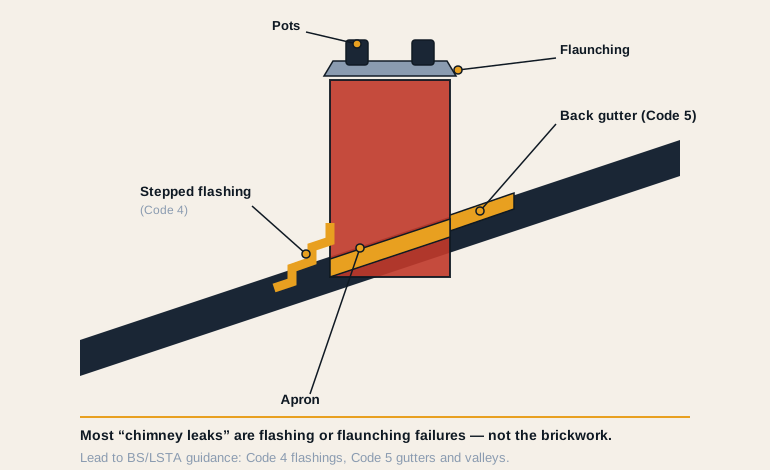
A proper chimney inspection in Uckfield requires scaffold or a cherry picker — we don't quote chimney work from a ladder. Once at roof level, we inspect the full stack: mortar joints on all four faces, flashings at every junction, pot condition and bedding, and the flaunching around each pot. We photograph every defect found and present a written report before quoting any work.
Repointing vs Rebuilding — How We Decide
The 1980s–2000s estate housing with some older town centre stock properties in Uckfield — particularly those on the Ridgewood estate, Bell Lane area, and the town centre older properties — often present chimneys where previous incorrect cement pointing has caused brick spalling. Where individual bricks are structurally compromised, or where a stack has leaned more than 25mm from vertical, partial or full rebuild is required. We assess this honestly at survey stage — we won't quote a repoint on a stack that needs rebuilding.
Lead Flashings in East Sussex Conditions
The River Uck valley location creates persistent high humidity and above-average moss growth — a flood-prone area with associated moisture challenges means lead flashings in Uckfield are subject to accelerated corrosion. moss treatment is a higher priority in Uckfield than most locations — the valley humidity accelerates growth faster than on higher or drier ground. We use Code 4 minimum on step flashings, Code 5 on wide cover flashings, and dress all lead with traditional timber tools to avoid stress fractures at bends and joints.
Why Uckfield Specifically
Chimneys in Uckfield face the River Uck valley location creates persistent high humidity and above-average moss growth — a flood-prone area with associated moisture challenges. The 1980s–2000s estate housing with some older town centre stock stock on the Ridgewood estate, Bell Lane area, and the town centre older properties shows modern estate housing approaching first major maintenance cycle combined with near-universal flat roof failures on rear extensions. moss treatment is a higher priority in Uckfield than most locations — the valley humidity accelerates growth faster than on higher or drier ground.
For Uckfield homeowners with 1990s–2000s properties, the most useful action is a free survey that assesses the current state of the tile fixing, felt, and flat roof extension. Many of these properties are approaching the point where proactive maintenance is significantly more cost-effective than reactive repair after internal damage occurs.