Langney and Shinewater represent the largest post-war residential development in Eastbourne, built in phases from the late 1950s through the 1970s to house a rapidly growing town. The roofing consequences of that construction era are now fully apparent: concrete interlocking tiles on galvanised fixing nails, where the nails have a nominal 40–50 year service life in moderate conditions and rather less in the coastal humidity of this low-lying area near the Pevensey Levels.
Chimney stacks on post-war and 1960s–70s estates properties in Langney are among the most exposed elements of any roof. The low-lying coastal position with persistent moisture from the Pevensey Levels direction means that mortar joints, lead flashings, and brick faces are subjected to salt deposits, freeze-thaw cycling, and wind-driven moisture in ways that significantly accelerate deterioration compared to sheltered inland locations. The chimney stacks on properties in Shinewater estate, Langney Point, and the Princes Road area are a clear example — many haven't received specialist attention in decades and are showing the accumulated effect of endemic nail sickness across the entire estate housing stock — systematic fixing failure rather than isolated damage.
We carry out all chimney repair work in Langney to correct specification: lime mortar on pre-1930 brickwork, Code 4 minimum lead for flashings, correct pot profiles for the property era. We don't use Portland cement on Victorian or Edwardian brickwork — it's the wrong specification and causes spalling damage to the softer bricks used in that era.
How We Inspect Chimneys in Langney
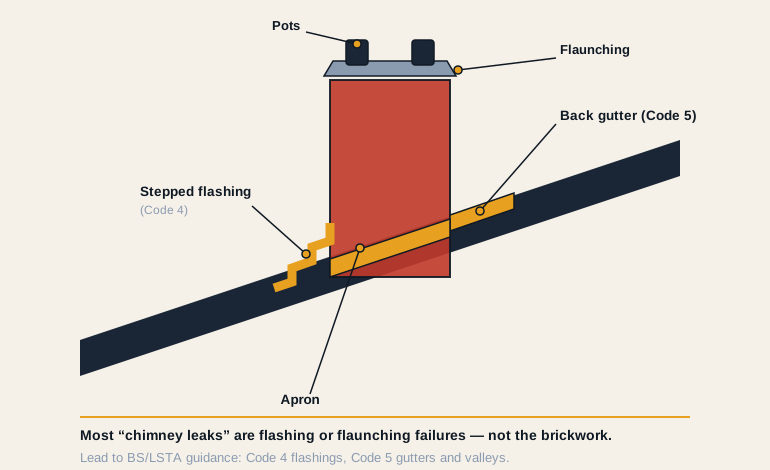
A proper chimney inspection in Langney requires scaffold or a cherry picker — we don't quote chimney work from a ladder. Once at roof level, we inspect the full stack: mortar joints on all four faces, flashings at every junction, pot condition and bedding, and the flaunching around each pot. We photograph every defect found and present a written report before quoting any work.
Repointing vs Rebuilding — How We Decide
The post-war and 1960s–70s estates properties in Langney — particularly those on Shinewater estate, Langney Point, and the Princes Road area — often present chimneys where previous incorrect cement pointing has caused brick spalling. Where individual bricks are structurally compromised, or where a stack has leaned more than 25mm from vertical, partial or full rebuild is required. We assess this honestly at survey stage — we won't quote a repoint on a stack that needs rebuilding.
Lead Flashings in East Sussex Conditions
The low-lying coastal position with persistent moisture from the Pevensey Levels direction means lead flashings in Langney are subject to accelerated corrosion. stainless steel screw re-fixing or full re-roof are the only viable long-term solutions — temporary tile replacement simply defers the inevitable. We use Code 4 minimum on step flashings, Code 5 on wide cover flashings, and dress all lead with traditional timber tools to avoid stress fractures at bends and joints.
Why Langney Specifically
Chimneys in Langney face the low-lying coastal position with persistent moisture from the Pevensey Levels direction. The post-war and 1960s–70s estates stock on Shinewater estate, Langney Point, and the Princes Road area shows endemic nail sickness across the entire estate housing stock — systematic fixing failure rather than isolated damage. stainless steel screw re-fixing or full re-roof are the only viable long-term solutions — temporary tile replacement simply defers the inevitable.
For Langney and Shinewater homeowners, the honest message is that nail sickness cannot be resolved with individual tile replacement — it is a systematic fixing failure that requires a systematic fix. A free survey will tell you the extent of fixing failure on your specific property and whether re-fixing or a full re-roof represents better long-term value.