Heathfield sits at over 200 metres on the High Weald ridge, making it one of the highest and wettest towns in East Sussex. The elevation is not academic from a roofing perspective: significantly higher annual rainfall than coastal East Sussex, more frost cycling than either the coast or the lower Weald, and a tree canopy that creates the persistent shade and moisture that moss requires to establish on roof surfaces within a very short time of any previous treatment.
Chimney stacks on Victorian and Edwardian town centre with 1980s estates and Wealden vernacular rural stock properties in Heathfield are among the most exposed elements of any roof. The one of the highest rainfall locations in East Sussex at 200m+ elevation — significantly more frost cycling than coastal locations means that mortar joints, lead flashings, and brick faces are subjected to salt deposits, freeze-thaw cycling, and wind-driven moisture in ways that significantly accelerate deterioration compared to sheltered inland locations. The chimney stacks on properties in Cross in Hand, the High Street Victorian properties, and the high-exposure ridge estates are a clear example — many haven't received specialist attention in decades and are showing the accumulated effect of moss and lichen growth is the fastest in the coverage area due to the combination of high rainfall, tree canopy, and reduced drying.
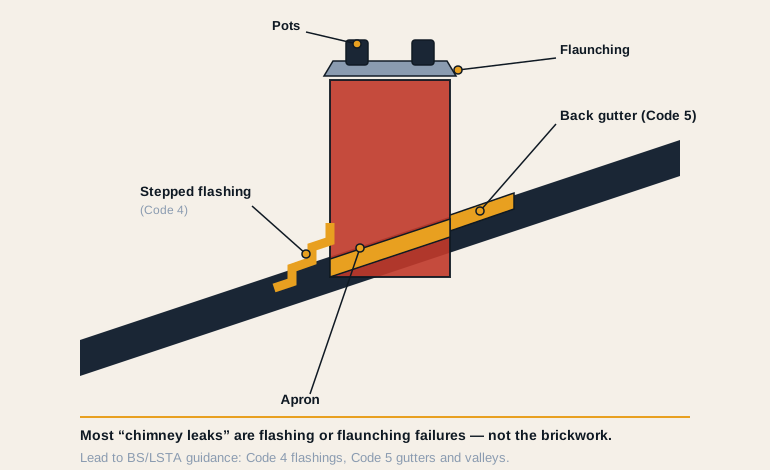
We carry out all chimney repair work in Heathfield to correct specification: lime mortar on pre-1930 brickwork, Code 4 minimum lead for flashings, correct pot profiles for the property era. We don't use Portland cement on Victorian or Edwardian brickwork — it's the wrong specification and causes spalling damage to the softer bricks used in that era.
How We Inspect Chimneys in Heathfield
A proper chimney inspection in Heathfield requires scaffold or a cherry picker — we don't quote chimney work from a ladder. Once at roof level, we inspect the full stack: mortar joints on all four faces, flashings at every junction, pot condition and bedding, and the flaunching around each pot. We photograph every defect found and present a written report before quoting any work.
Repointing vs Rebuilding — How We Decide
The Victorian and Edwardian town centre with 1980s estates and Wealden vernacular rural stock properties in Heathfield — particularly those on Cross in Hand, the High Street Victorian properties, and the high-exposure ridge estates — often present chimneys where previous incorrect cement pointing has caused brick spalling. Where individual bricks are structurally compromised, or where a stack has leaned more than 25mm from vertical, partial or full rebuild is required. We assess this honestly at survey stage — we won't quote a repoint on a stack that needs rebuilding.
Lead Flashings in East Sussex Conditions
The one of the highest rainfall locations in East Sussex at 200m+ elevation — significantly more frost cycling than coastal locations means lead flashings in Heathfield are subject to accelerated corrosion. biocide moss treatment every 2–3 years is a practical necessity in Heathfield — longer intervals result in significant tile and mortar degradation. We use Code 4 minimum on step flashings, Code 5 on wide cover flashings, and dress all lead with traditional timber tools to avoid stress fractures at bends and joints.
Why Heathfield Specifically
Chimneys in Heathfield face the one of the highest rainfall locations in East Sussex at 200m+ elevation — significantly more frost cycling than coastal locations. The Victorian and Edwardian town centre with 1980s estates and Wealden vernacular rural stock stock on Cross in Hand, the High Street Victorian properties, and the high-exposure ridge estates shows moss and lichen growth is the fastest in the coverage area due to the combination of high rainfall, tree canopy, and reduced drying. biocide moss treatment every 2–3 years is a practical necessity in Heathfield — longer intervals result in significant tile and mortar degradation.
For Heathfield homeowners, the practical recommendation is a biocide moss treatment every 2–3 years combined with annual gutter clearing — the minimum maintenance regime for this elevation and rainfall level. Properties that have gone 5+ years without treatment typically require a more intensive intervention and often reveal ridge and pointing failures that have been masked by the moss coverage.