Hailsham is a market town six miles north-west of Eastbourne in the Pevensey Levels basin, and that geographic position shapes its roofing environment in ways that differ significantly from the coastal town. The basin location creates persistent high humidity and above-average annual rainfall compared to the surrounding higher ground. The Cuckoo Trail — the former railway line converted to a recreational path — runs along the western edge of the town, and properties adjacent to it sit under a tree canopy that generates the leaf fall, moss growth, and valley blockage that constitute our most common autumn call-out in Hailsham.
Chimney stacks on Victorian town centre terraces and 1970s–80s residential estates properties in Hailsham are among the most exposed elements of any roof. The Pevensey Levels basin location creates above-average moisture and persistent valley damp means that mortar joints, lead flashings, and brick faces are subjected to salt deposits, freeze-thaw cycling, and wind-driven moisture in ways that significantly accelerate deterioration compared to sheltered inland locations. The chimney stacks on properties in the Vicarage Field estates, the High Street Victorian terraces, and the Cuckoo Trail corridor are a clear example — many haven't received specialist attention in decades and are showing the accumulated effect of nail sickness on Vicarage Field-area estates and valley blockages from the Cuckoo Trail tree canopy causing autumn leak calls.
We carry out all chimney repair work in Hailsham to correct specification: lime mortar on pre-1930 brickwork, Code 4 minimum lead for flashings, correct pot profiles for the property era. We don't use Portland cement on Victorian or Edwardian brickwork — it's the wrong specification and causes spalling damage to the softer bricks used in that era.
How We Inspect Chimneys in Hailsham
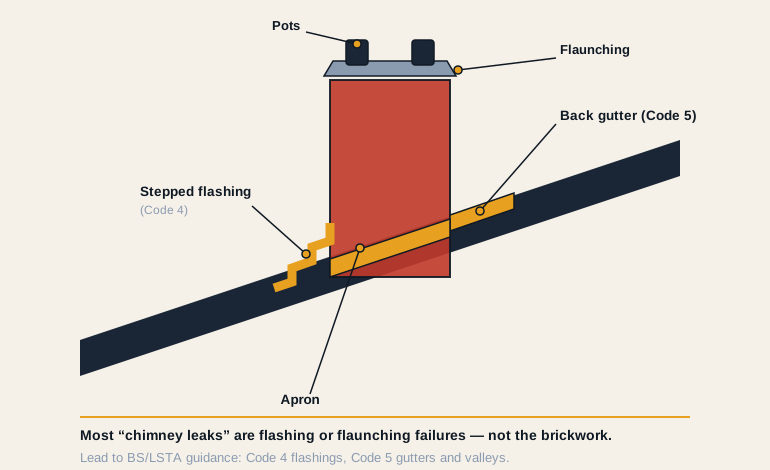
A proper chimney inspection in Hailsham requires scaffold or a cherry picker — we don't quote chimney work from a ladder. Once at roof level, we inspect the full stack: mortar joints on all four faces, flashings at every junction, pot condition and bedding, and the flaunching around each pot. We photograph every defect found and present a written report before quoting any work.
Repointing vs Rebuilding — How We Decide
The Victorian town centre terraces and 1970s–80s residential estates properties in Hailsham — particularly those on the Vicarage Field estates, the High Street Victorian terraces, and the Cuckoo Trail corridor — often present chimneys where previous incorrect cement pointing has caused brick spalling. Where individual bricks are structurally compromised, or where a stack has leaned more than 25mm from vertical, partial or full rebuild is required. We assess this honestly at survey stage — we won't quote a repoint on a stack that needs rebuilding.
Lead Flashings in East Sussex Conditions
The Pevensey Levels basin location creates above-average moisture and persistent valley damp means lead flashings in Hailsham are subject to accelerated corrosion. valley maintenance and gutter clearance are annual requirements given the tree canopy load from the Cuckoo Trail. We use Code 4 minimum on step flashings, Code 5 on wide cover flashings, and dress all lead with traditional timber tools to avoid stress fractures at bends and joints.
Why Hailsham Specifically
Chimneys in Hailsham face the Pevensey Levels basin location creates above-average moisture and persistent valley damp. The Victorian town centre terraces and 1970s–80s residential estates stock on the Vicarage Field estates, the High Street Victorian terraces, and the Cuckoo Trail corridor shows nail sickness on Vicarage Field-area estates and valley blockages from the Cuckoo Trail tree canopy causing autumn leak calls. valley maintenance and gutter clearance are annual requirements given the tree canopy load from the Cuckoo Trail.
For Hailsham homeowners, the combination of valley moisture, significant tree canopy, and an aging housing stock creates a maintenance requirement that rewards regular attention over reactive repair. Annual gutter clearing and 3-yearly roof surveys are the most cost-effective approach to avoiding the larger costs that follow from deferred maintenance in this environment.