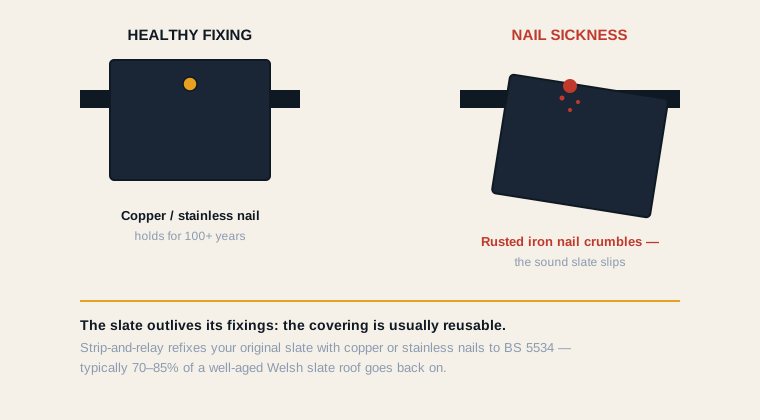
Meads sits on the elevated ground between Eastbourne town centre and Beachy Head, and its roofing challenges are shaped by that geography as much as by the exceptional quality of its Victorian and Edwardian housing stock. Properties on the exposed west and south aspects of Meads Road and Granville Road catch the full force of south-westerly Atlantic weather systems. Clay plain tile and natural Welsh slate are the dominant materials here — and in the Meads Conservation Area, they are also the required materials for any replacement work.
A full roof replacement in Meads is a significant investment, and getting the specification right from the start is the difference between a roof that lasts 40 years and one that needs attention in 15. The Victorian and Edwardian villas and terraces in Meads — including properties on Granville Road, Carlisle Road, and Compton Place Road — require different approaches depending on age, construction, and the direct Channel exposure on south and west faces with salt-laden south-westerlies that these roofs are exposed to.
We carry out full re-roofs across Meads using materials correctly specified for East Sussex conditions. all lead work specified to coastal code weights and all mortar in lime mix due to Victorian brickwork. Every re-roof includes new breathable membrane, new treated battens, and a 10-year written workmanship guarantee.
Survey and Specification for Meads Properties
Before any re-roof quote, we carry out a full survey: condition of existing tiles, felt, battens, and timber structure. We assess the specific issues relevant to Meads properties — salt-accelerated lead corrosion on chimney stacks and clay tile slippage from corroded nibs — and include any identified structural work in the quote. There are no hidden costs on a re-roof.
Re-Roofing Process Step by Step
Scaffold erection → strip existing covering → inspect and repair timber structure → new breathable membrane → new counter-battens and tile battens → tile laying → ridge and hip completion → all flashings → scaffold removal → full site clean-up. We ensure the roof is weathertight at the end of every working day throughout.
How Long a New Meads Roof Will Last
A correctly specified and installed roof in East Sussex conditions should last 40–60 years for quality concrete or clay tiles, and 80–100 years for natural slate. The key variable is the quality of the installation — specifically the membrane, batten fixing, and flashing details. We don't cut corners on any of these.
Why Meads Specifically
Re-roofing Meads properties requires understanding the Victorian and Edwardian villas and terraces stock and the direct Channel exposure on south and west faces with salt-laden south-westerlies. salt-accelerated lead corrosion on chimney stacks and clay tile slippage from corroded nibs. all lead work specified to coastal code weights and all mortar in lime mix due to Victorian brickwork.
For homeowners in Meads, the practical implications are clear: work on these properties requires a roofer who holds stock of period clay tiles, understands lime mortar specification, carries Code 5 lead as standard, and knows the conservation consent process. We carry out work on Meads properties regularly and hold the material relationships to source matched tiles quickly when needed.