Roof repairs in Eastbourne typically cost £150–£900 depending on the issue, from slipped tiles to lead flashing and ridge work. Every repair starts with a roof-level inspection and a written quote — no call-out fee. Eastbourne Roofing Experts covers all of East Sussex with a 10-year guarantee. Call 01323 365960.
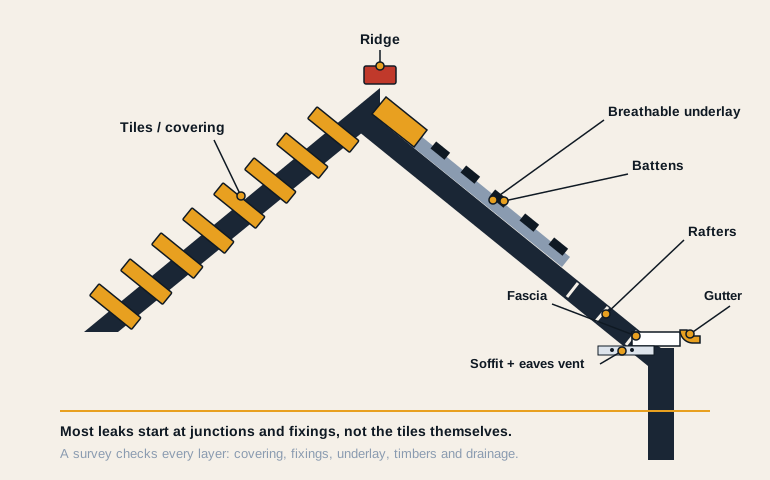
Do You Actually Need Roof Repairs?
Most roof problems announce themselves inside the house before they are visible outside. Here is how to tell a genuine roof repair from a false alarm.
- A damp patch or brown ring on an upstairs ceiling that grows after rain
- A slipped, cracked or missing tile visible from the ground or a neighbour's window
- Debris — granules, mortar crumbs or tile fragments — in the gutters or on the drive
- Daylight or drips visible in the loft during or after heavy weather
- Damp or staining around a chimney, valley or where a flat roof meets a wall
When it is not the answer: If tiles are slipping across the whole roof rather than in one spot, tile-by-tile repair is money wasted — that is comprehensive fixing failure, and a re-fix or replacement ends it for good. Read the full guide.
Roofing in Eastbourne: Local Knowledge
What fails on an Eastbourne roof depends almost entirely on where in the town it sits. On the post-war concrete-tile estates of Langney, Shinewater and the Brodrick Road side of Hampden Park, the commonest repair call is slipped tiles caused by early nail sickness — the galvanised fixing nails corroding in the salt air. On the Victorian and Edwardian terraces of Meads, Upperton and Old Town, it is slipped slates, tired lead valleys and flashing failure around the tall shared chimney stacks.
The 1930s hipped semis of Roselands and older Hampden Park bring their own signature repair: 85-to-90-year-old hip and ridge mortar finally letting go, which we re-bed and repoint to BS 5534. Along the seafront and Grand Parade, the marine exposure is relentless — we specify Code 5 lead and stainless fixings as standard here, not as an upsell, because cheaper materials simply do not last against salt-laden south-westerlies. Knowing which failure belongs to which street is half the job, and it is why a local Eastbourne roofer beats a general one on a repair.
What to Expect: Roof Repairs in Eastbourne
1. Survey
We inspect from the roof and the loft, find the actual source of the water (often a metre or more from where it shows inside), and photograph it so you can see it too.
2. Written itemised quote
You get a fixed written price naming the materials — including Code 5 lead and stainless fixings as standard on this coast — with no vague lump sums.
3. Scheduling & access
We book a date and arrange a tower, roof ladder or scaffold as the job needs, plus any council permit where the highway is affected.
4. The repair
We carry out the repair, check the surrounding area for anything about to fail, and re-test for water-tightness before we leave.
5. Cleanup & sign-off
We clear all debris, magnet-sweep for nails, and hand over your written guarantee.
How Long Does It Take?
| Job | Typical duration |
|---|---|
| Slipped or cracked tile refix | 1–2 hours |
| Localised leak trace & repair | Half a day |
| Chimney flashing repair | Half to full day |
| Rear valley rebuild | 2–3 days |
Wet or high-wind days pause tiling and leadwork, so on exposed seafront and Meads roofs we hold weather margin and fit temporary weatherproofing if rain stops play.
Getting Safely onto Eastbourne Roofs
Most repairs run safely from a tower or roof ladder; scaffold is quoted only where the job needs safe standing time at height. Scaffold is specified for: chimney-side repairs, valley rebuilds, work on tall seafront elevations, or anything beyond a day at height - always itemised in your written quote, never a hidden extra, and we arrange it.
Eastbourne's Victorian and Edwardian terraces in Meads, Upperton and Old Town often have no side access, so scaffold reaches the rear over the roofline or through the property; seafront mansion blocks need tall scaffold licences for parapet and stack work. Pavement scaffold and skip permits go through East Sussex County Council; allow a few working days on streets like Church Street in Old Town, the terraces off Seaside, Grange Road in Upperton where space is tight.
Roof Repairs Prices in Eastbourne
| Job | Typical range | Notes |
|---|---|---|
| Slipped/cracked tile refix | £150–£250 | Per visit, incl. access |
| Localised leak trace & repair | £250–£450 | Depends on source |
| Chimney flashing repair | £300–£650 | Code 5 lead, coastal-grade |
| Valley repair / rebuild | £450–£900 | Lead or GRP valley |
| Ridge / hip re-bed (per section) | £300–£700 | Repointing to BS 5534 |
What moves the price
- Roof height and access — no side access on many Meads/Old Town terraces means scaffold
- Whether marine-grade lead and stainless fixings are needed (standard on this coast)
- How far the leak has tracked from where it shows inside
- Conservation-area material matching in Meads and Old Town
Worked example: A slipped-tile refix plus a short length of failed ridge on a 1930s semi in Roselands: about £380 including tower access and re-bedding.
No deposit on repairs under £500. Staged payments on larger jobs — nothing up front before materials are on site.
Covering BN20, BN21, BN22, BN23, BN24 and surrounding postcodes.
Your Guarantee, Explained
Workmanship on the repaired section is guaranteed for 10 years in writing; any replacement tiles or lead carry manufacturer warranties on top.
- Covered: workmanship for 10 years, in writing, transferable if you sell.
- On top: manufacturer warranties on materials (terms vary by product).
- Not covered: storm or impact damage - that is an insurance matter, and we will document it for your claim.
If a fault appears in covered work, we come back and put it right. No quibbling, no re-charge.
What It Is Like While We Work
A repair is usually a day of ladder or tower work and a small amount of debris. We sheet below the work area, protect planting, and clear everything before we leave. You do not need to stay home for external work - we just need power and access agreed in advance.
Repairs run year-round in Eastbourne; if rain interrupts a job, temporary weatherproofing goes on the same day and we return to finish. Channel salt air ages lead and fixings faster here than inland, and the south-west prevailing wind drives rain onto exposed western and seafront elevations, so we build weather margin into every Eastbourne booking.
Roof repair in Eastbourne requires a different approach depending on where in the town you live and what era your property dates from. The Victorian and Edwardian terraces in Meads and Old Town use clay peg tiles and natural slate that demand specialist sourcing and fixing methods. The 1930s semis of Hampden Park need careful attention to their original clay and early concrete tile beds. The post-war estates in Langney and Shinewater have concrete interlocking tiles on battens that are now frequently showing nail sickness — failure from the inside, invisible until tiles begin to slip or crack.
On top of the property age variation, Eastbourne's coastal position means salt-accelerated corrosion is a constant factor. Lead flashings around chimney stacks and roof abutments corrode faster here than in inland areas. Steel fixing nails oxidise. Mortar ridges and verges crack where they’ve been saturated repeatedly by wind-driven rain off the Channel.
Common Roof Repairs We Handle in Eastbourne
- Slipped or missing clay peg tiles on Victorian and Edwardian properties in Meads and Old Town
- Nail-sick concrete interlocking tiles on post-war estates in Langney and Shinewater
- Lead flashing failures around chimney stacks — salt corrosion a key cause
- Mortar ridge and hip repairs — salt and frost cycling breaks down joints rapidly
- Valley failures causing internal leakage — common on 1930s properties in Hampden Park
- Flat roof repairs on rear extensions after storm uplift