Hailsham is a market town six miles north-west of Eastbourne in the Pevensey Levels basin, and that geographic position shapes its roofing environment in ways that differ significantly from the coastal town. The basin location creates persistent high humidity and above-average annual rainfall compared to the surrounding higher ground. The Cuckoo Trail — the former railway line converted to a recreational path — runs along the western edge of the town, and properties adjacent to it sit under a tree canopy that generates the leaf fall, moss growth, and valley blockage that constitute our most common autumn call-out in Hailsham.
Flat roofing failures are the most common source of water ingress we encounter on Victorian town centre terraces and 1970s–80s residential estates properties in Hailsham. The rear extensions, garage roofs, and bay window flat sections added to Hailsham's housing stock over the decades are now at various stages of their service life — and the Pevensey Levels basin location creates above-average moisture and persistent valley damp accelerates degradation faster than owners typically expect.
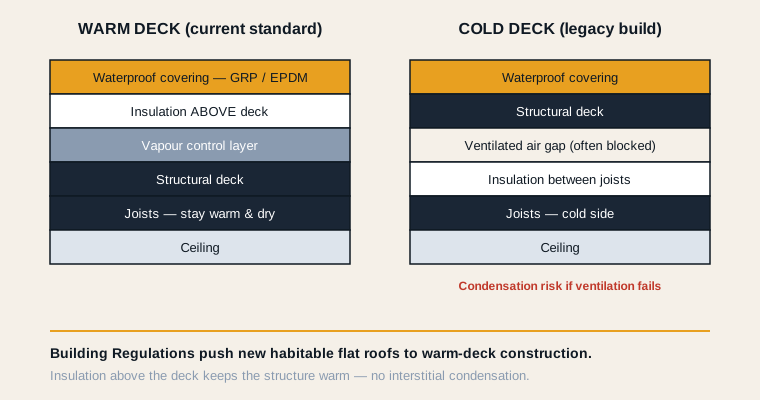
We install GRP fibreglass and EPDM rubber flat roofing systems only — no torch-on felt for new installations. Both systems, correctly installed, last 25+ years in East Sussex conditions. The difference in longevity compared to felt makes the modest additional cost a straightforward decision.
Flat Roof Drainage in Hailsham — Getting It Right
Drainage falls are the most commonly botched element of flat roofing in Hailsham. A flat roof needs a minimum 1:80 fall to drain correctly. Many of the extensions and garage roofs on Victorian town centre terraces and 1970s–80s residential estates properties were built with inadequate or zero falls — water ponds, accelerating membrane degradation and ultimately causing the leaks that bring us out. We always assess and correct falls as part of any flat roof replacement.
Deck Inspection — What We Find Under the Old Roof
When we strip an old flat roof in Hailsham, the condition of the timber deck beneath is the critical unknown. Properties in the Vicarage Field estates, the High Street Victorian terraces, and the Cuckoo Trail corridor frequently have waterlogged OSB or plywood decking from years of slow ingress — this must be replaced before any new covering goes down. We include deck inspection in every survey and price deck replacement transparently in the quote.
Maintenance for Hailsham Flat Roofs
GRP and EPDM flat roofs need minimal maintenance — an annual check of perimeter trims and outlet clearance is all that's required. Given the Pevensey Levels basin location creates above-average moisture and persistent valley damp, gutter and outlet clearance is more important in Hailsham than inland locations. We can include flat roofs in an annual maintenance visit if required.
Why Hailsham Specifically
Flat roofs in Hailsham are subject to the Pevensey Levels basin location creates above-average moisture and persistent valley damp. nail sickness on Vicarage Field-area estates and valley blockages from the Cuckoo Trail tree canopy causing autumn leak calls. Properties on the Vicarage Field estates, the High Street Victorian terraces, and the Cuckoo Trail corridor particularly benefit from valley maintenance and gutter clearance are annual requirements given the tree canopy load from the Cuckoo Trail.
For Hailsham homeowners, the combination of valley moisture, significant tree canopy, and an aging housing stock creates a maintenance requirement that rewards regular attention over reactive repair. Annual gutter clearing and 3-yearly roof surveys are the most cost-effective approach to avoiding the larger costs that follow from deferred maintenance in this environment.