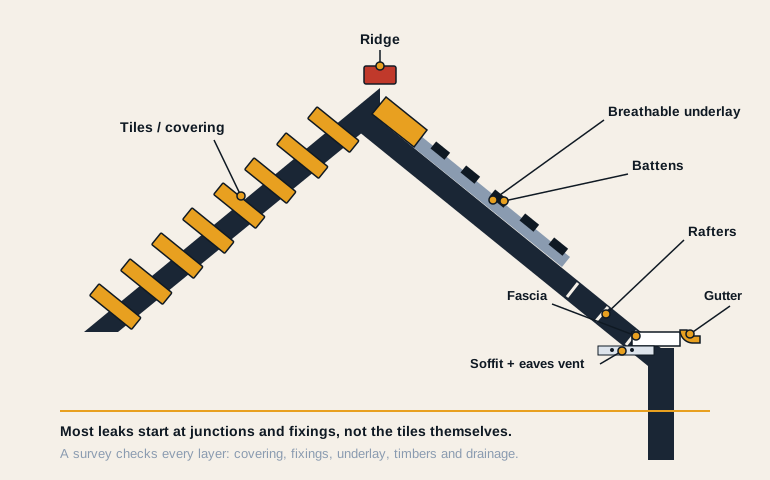
Heathfield sits at over 200 metres on the High Weald ridge, making it one of the highest and wettest towns in East Sussex. The elevation is not academic from a roofing perspective: significantly higher annual rainfall than coastal East Sussex, more frost cycling than either the coast or the lower Weald, and a tree canopy that creates the persistent shade and moisture that moss requires to establish on roof surfaces within a very short time of any previous treatment.
Roof window installation in Heathfield requires careful handling regardless of the property type. On Victorian and Edwardian town centre with 1980s estates and Wealden vernacular rural stock properties — particularly those in Cross in Hand, the High Street Victorian properties, and the high-exposure ridge estates — the Horsham stone on oldest properties, clay plain tile on Victorian stock, concrete on modern estates demands specific flashing kits and installation approaches that generic fitters don't always get right. A leaking roof window is almost always a flashing failure, not a unit failure — and in the one of the highest rainfall locations in East Sussex at 200m+ elevation — significantly more frost cycling than coastal locations that Heathfield experiences, incorrect flashing detail fails faster than it would inland.
We install Velux and equivalent branded roof windows across Heathfield, from single loft lights to multiple-window loft conversion installations. We also repair and re-flash existing units — in the majority of leaking Velux cases the unit itself is fine and a correct flashing replacement resolves the problem for a fraction of unit replacement cost.
Correct Flashing for Heathfield Properties
The Horsham stone on oldest properties, clay plain tile on Victorian stock, concrete on modern estates used on Victorian and Edwardian town centre with 1980s estates and Wealden vernacular rural stock properties in Heathfield requires specific flashing kit selection. Generic kits don't accommodate the profile variation across East Sussex's period housing stock. We specify the correct manufacturer flashing kit for the exact tile type in use, with additional lead soakers on plain tile installations. The result is a watertight junction that performs correctly in the wind-driven rain Heathfield experiences from the one of the highest rainfall locations in East Sussex at 200m+ elevation — significantly more frost cycling than coastal locations.
Leaking Velux Windows in Heathfield
Leaking roof windows on Victorian and Edwardian town centre with 1980s estates and Wealden vernacular rural stock properties in Heathfield are almost always a flashing failure — either original installation was incorrect or the flashing has degraded over time in East Sussex's coastal conditions. We inspect the flashing detail first before recommending unit replacement. In 80% of cases we encounter in Heathfield, a correct flashing replacement resolves the leak without touching the unit.
Conservation Area Installations in Heathfield
No specific conservation constraints apply in Heathfield for standard roofing work. Where conservation restrictions apply, we specify slim-profile conservation roof lights that sit flush with the roof plane and meet planning requirements. We handle the consent process where needed.
Why Heathfield Specifically
Velux installations in Heathfield must be correctly flashed for the Horsham stone on oldest properties, clay plain tile on Victorian stock, concrete on modern estates and one of the highest rainfall locations in East Sussex at 200m+ elevation — significantly more frost cycling than coastal locations. Properties in Cross in Hand, the High Street Victorian properties, and the high-exposure ridge estates require biocide moss treatment every 2–3 years is a practical necessity in Heathfield — longer intervals result in significant tile and mortar degradation.
For Heathfield homeowners, the practical recommendation is a biocide moss treatment every 2–3 years combined with annual gutter clearing — the minimum maintenance regime for this elevation and rainfall level. Properties that have gone 5+ years without treatment typically require a more intensive intervention and often reveal ridge and pointing failures that have been masked by the moss coverage.