Willingdon occupies a transitional position between the urban mass of Eastbourne and the open South Downs: the old village centre with its flint church and pre-war housing stock sits alongside 1970s and 1980s residential estates that spread across the valley sides toward Wish Hill. The elevated position — significantly higher than the coastal town below — gives Willingdon a wind exposure profile that surprises owners who expect conditions similar to Eastbourne's sheltered town centre.
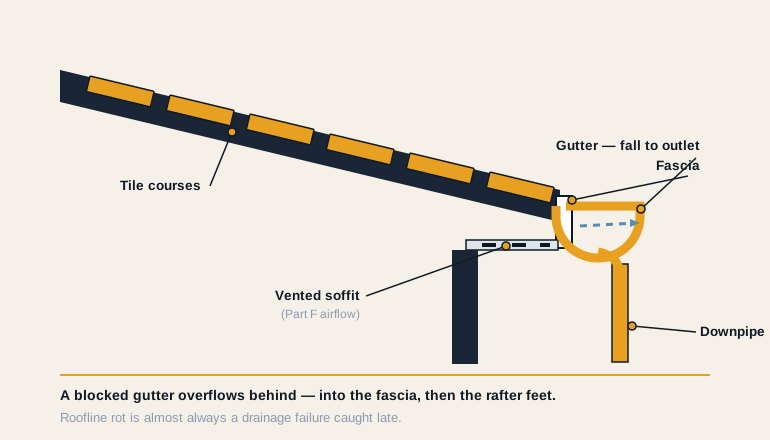
Fascias, soffits, and bargeboards on pre-war village stock and 1970s–80s residential estates properties in Willingdon face accelerated deterioration from the elevated Downs-facing position with higher wind exposure than valley Eastbourne — particularly on Wish Hill properties. UPVC becomes brittle and joints fail prematurely; timber fascias on older properties absorb moisture and rot faster than in sheltered inland locations. When they fail, water gets behind them — saturating rafter feet, introducing damp into the roof structure, and eventually causing the structural rot we find on properties across Wish Hill, the old village centre near Willingdon Church, and the Upper Willingdon area every month.
We replace fascias, soffits, and bargeboards across Willingdon in UV-stabilised, salt-resistant UPVC with stainless steel fixings throughout. For Victorian and Edwardian properties in Willingdon, we specify ogee and bull-nose profiles that maintain period character. For modern estate housing, square-edge profiles are the practical and cost-effective choice.
Why Willingdon Properties Need Correct-Spec Fascia Systems
Standard UPVC is manufactured for inland exposure. In East Sussex, we specify products rated for coastal environments — higher UV stability, better salt resistance, and stainless steel fixings that won't corrode within a decade. mechanical tile fixing is specified throughout on any Willingdon re-roof given the elevated wind exposure — standard mortar bedding is not adequate. The additional cost over standard products is small; the additional service life is significant.
When to Replace vs Repair
If UPVC fascias have multiple cracks, are sagging at multiple points, or brackets have failed repeatedly, replacement is the right decision. For timber fascias showing soft spots, peeling paint, or section rot, targeted repair may work if the damage is limited — but widespread rot means full replacement. We assess honestly at survey stage.
Guttering at the Same Time
On pre-war village stock and 1970s–80s residential estates properties in Willingdon, we always quote fascia and gutter replacement together. The gutters come down to access the fascias — fitting new fascias and re-hanging old guttering is a false economy on properties where the gutter system is at the same age and condition as the fascia.
Why Willingdon Specifically
Fascias and soffits on Willingdon properties are exposed to the elevated Downs-facing position with higher wind exposure than valley Eastbourne — particularly on Wish Hill properties. The pre-war village stock and 1970s–80s residential estates stock in Wish Hill, the old village centre near Willingdon Church, and the Upper Willingdon area presents wind uplift on exposed north and west faces combined with nail sickness on the 1970s–80s estate stock. mechanical tile fixing is specified throughout on any Willingdon re-roof given the elevated wind exposure — standard mortar bedding is not adequate.
For Willingdon homeowners — particularly those on the elevated Wish Hill and Upper Willingdon areas — the wind exposure factor is worth taking seriously at re-roof time. The additional cost of fully mechanical tile fixing over standard mortar bedding is modest; the difference in performance on an exposed roof in a severe storm is significant.